Education Is The New Pipeline: How The Fastest-Growing Software Companies Accelerate Growth Through Developer Education

Education Is The New Pipeline: How The Fastest-Growing Software Companies Accelerate Growth Through Developer Education
Most developer tools companies have a free tier. Most of them also have the same problem: thousands of signups, a thin conversion rate, and no clear picture of what happened in between. The assumption is that access equals adoption—give developers the product and they'll figure it out. Some will. Most won't.
The companies pulling away from the pack have stopped treating education as what happens after the sale. They've made it the growth engine itself—the thing that turns a curious developer into a competent one, and a competent one into an internal champion, before procurement is ever involved.
Developer-led growth flips the funnel
Most enterprise software companies still run the same playbook: generate awareness, qualify leads, run a demo, negotiate a contract, then hand the customer off to onboarding. The product is something the buyer earns access to after navigating that process.
Developer-led growth (DLG) inverts that sequence. A developer discovers the tool, runs something real in minutes, and builds conviction through direct experience. By the time procurement gets involved, the technical decision is already made. Developers are professionally skeptical buyers—they discount marketing claims and vendor promises by default. A five-minute sandbox that actually runs beats a fifty-slide deck every time.
This changes the economics of growth in two ways. First, bottom-up adoption is sticky: when a developer integrates your SDK or CLI into their daily workflow, they become the internal advocate who says "I've used this, it works" when the team evaluates options. Second, it compresses deal cycles. Sales enters the picture and the conversation shifts from "does this work?" to "how do we expand?" That advocacy and that velocity are worth more than any marketing campaign you can buy.
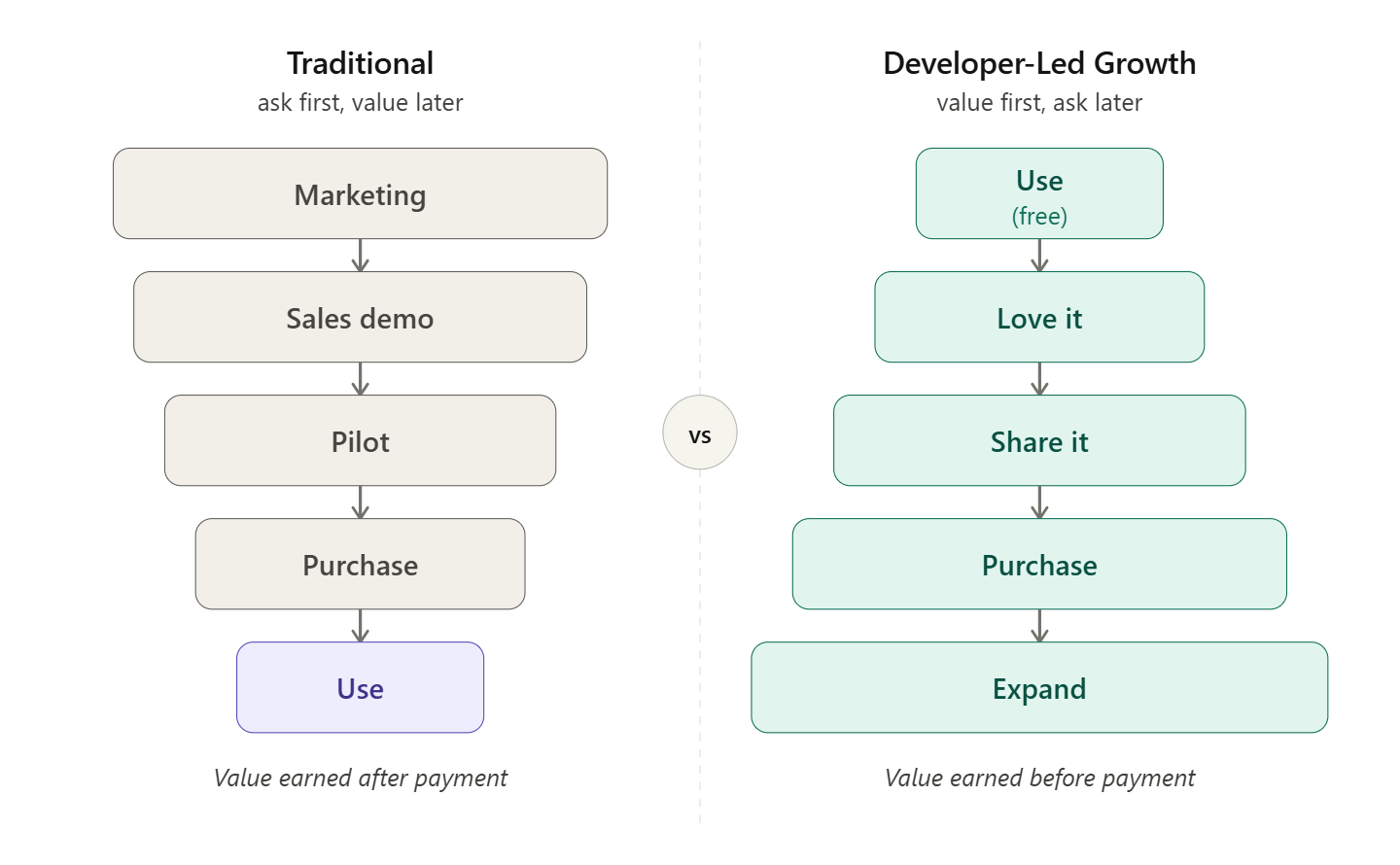
The shape tells the story. Traditional funnels narrow toward use. DLG funnels expand from it.
The gap most free tiers leave open
A free tier is often the first move in a DLG strategy, and for good reason. It removes the single biggest barrier in developer adoption: having to ask permission before getting value. No procurement form. No credit card. No 30-minute demo call. A developer goes from hearing about a product to having something running in minutes, on their own time.
Done well, that first experience builds muscle memory. Your API patterns, your CLI commands, and your mental model become their default. Trust is earned through demonstrated reliability rather than promised reliability.
But most free tiers have a ceiling. They hand developers the product and say "go"—no structure, no guided path, no way to distinguish between a developer who browsed for two minutes and one who worked through a real use case. Most developers who sign up stall before they reach the moment that would have made them advocates.
That gap between awareness and conviction is where most DLG strategies leak.
This is the gap that platforms like Instruqt are designed to close.
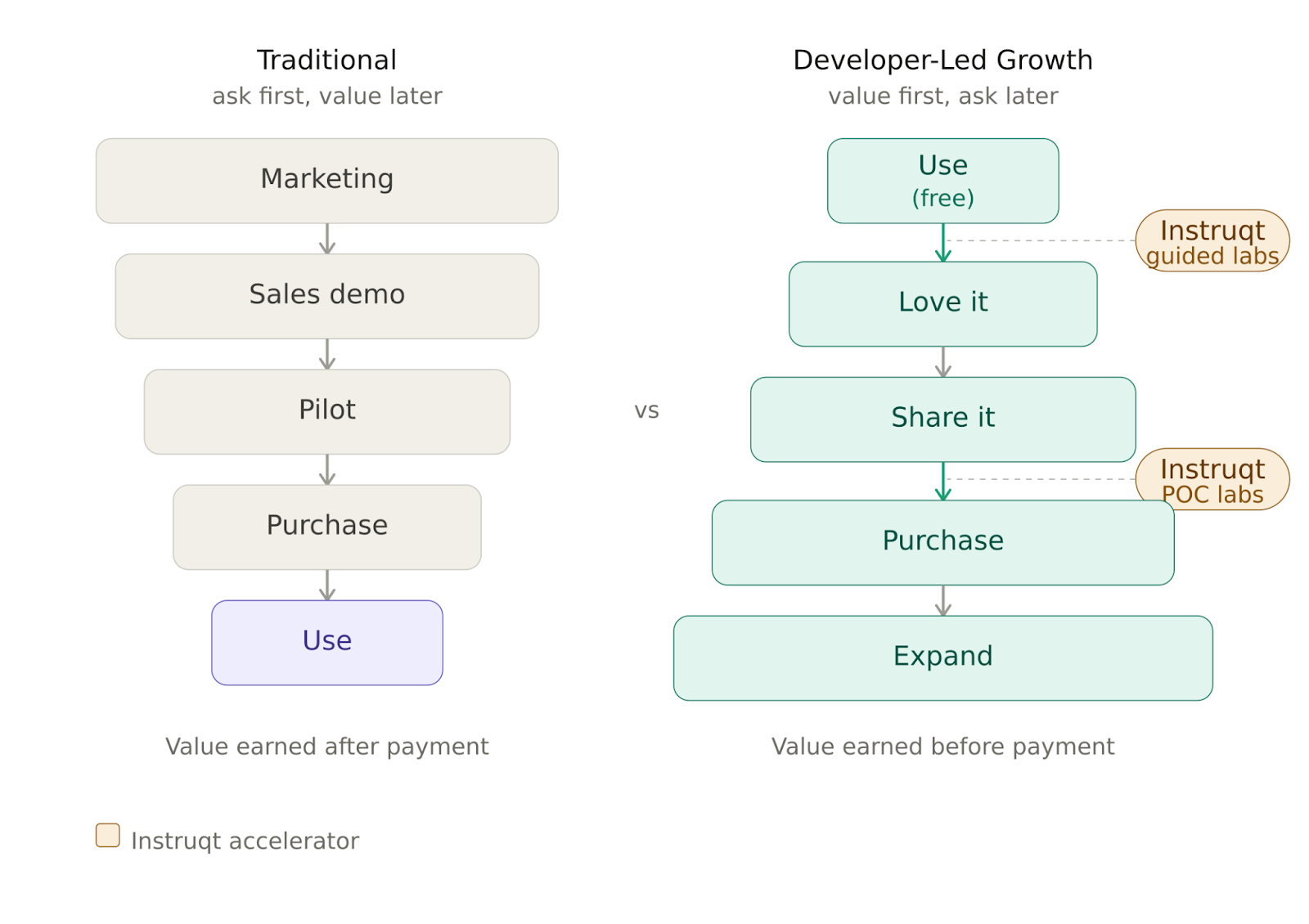
Instruqt accelerates the two transitions where most DLG funnels stall: getting developers to conviction, and shortening the POC cycle.
What closing that gap actually looks like
The fastest-growing developer-focused companies have moved beyond free access. They are building free, scalable education experiences that guide developers from first contact to genuine competence—at a scale that would be impossible with traditional training.
MongoDB University is the clearest example. Every course is free, self-paced, and available on demand—covering everything from CRUD basics to production-grade architecture. Developers arrive at any point in their journey and leave with both skills and credentials. Roughly 200,000 developers are added to MongoDB's ecosystem every month. That scale is only achievable because the education is structured, repeatable, and delivers value without a human in the loop. The shift to interactive lab environments made the difference tangible.
"Suddenly, instead of spending up to 15 minutes configuring, downloading, doing all the pieces, the student would jump straight in, connected to a cluster, at the prompt doing exactly what we wanted to teach them."
— Eoin Brazil, Senior Staff Engineer, MongoDB
Fifteen minutes of friction at the top of a learning experience is enough to lose most developers before they reach the part that matters.
HashiCorp takes a similar approach through its developer portal. Terraform, Vault, Consul, and the rest of the suite come with step-by-step, command-line tutorials built around hosted terminal sessions. Developers provision real infrastructure in the browser, against real cloud providers. A developer new to Terraform and a senior engineer studying for certification are both served by the same system, at their own pace, with zero local setup required.
Isovalent, now part of Cisco, built a labs library covering eBPF, Cilium, and Kubernetes security—among the most technically demanding topics in the infrastructure space. The complexity of the subject matter makes the frictionlessness of the experience notable. As Raphaël Pinson, Senior Technical Marketing Engineer at Isovalent, put it: developers "just jump right in and start learning"—no local environment, no prerequisites, and no wait for provisioned infrastructure.
Elastic extends this thinking into the pre-sales experience. Their demo gallery lets prospects experience AI-powered search in a live environment before any sales conversation begins. The evaluation starts the moment someone clicks through—no setup, trial request, or waiting. By the time a prospect talks to a solutions architect, they have already formed a view of the product through their own hands-on experience.
The key shift is that education is no longer just enablement—it’s a measurable pipeline input. The teams doing this well can tie learning engagement directly to deal creation and expansion.
Where the market is heading
MongoDB, HashiCorp, Isovalent, and Elastic have each made education scalable, free, and measurable—and built it into the growth motion from the start. A free tier offers access and waits. Scalable developer education guides developers through the experiences most likely to create conviction, tracks where they succeed and where they stall, and connects that engagement data to the broader business.
The practical implication is direct: if your product is technical, your best sales motion is a developer who already knows how to use it. The question is how you get them there at a scale that actually moves the business.
Making it work at scale
Building education experiences that drive growth requires different thinking than building a knowledge base. A lab that requires local setup loses developers before they start. A guided path without real infrastructure teaches patterns but not practice. Analytics that track completion without context—time spent, tasks completed, where developers stall—tell you what happened, not what to do about it.
The teams building this well focus on three things: getting developers to value fast, replicating that experience for every developer who comes after, and connecting learning engagement to pipeline signals the broader business can act on.
If you're still treating education as post-sale enablement, start here: take your highest-friction onboarding step—the one where developers drop off—and replace it with a guided, hands-on lab they can finish in under ten minutes. Measure what happens to activation. That single change will tell you more about where your growth is leaking than any funnel dashboard. And it starts with a decision: education is how you earn the right to have the sales conversation, not what happens after it.
Want to see how teams like MongoDB, Elastic, and HashiCorp are building scalable developer education experiences? Explore how Instruqt powers hands-on learning across the full buyer's journey.


.jpg)